Hamza’s story: "He knows that he can do it"
Chapter One has helped Hamza, a pupil in Birmingham, go from being scared about trying to reading three books in a session
Permanently excluded from his mainstream primary midway through Year 5, Hamza* arrived at his new school with almost no spoken English - and no reading to speak of.
"When he first arrived, we weren't really getting much out of him in terms of any work," says Leah Bennett, a teacher at Moseley Heath Campus and the Inclusion Manager. "I think Hamza was a bit scared about trying."
Moseley Heath Campus is the primary site of City of Birmingham School, an alternative provision school serving children from across the city, with one primary and six secondary campuses and more than 120 pupils on roll. Almost all come from socio-economically deprived backgrounds; in Birmingham, more than two in five children under 16 live in low-income families - among the highest rates of any English city and well above the national average.
Chapter One does not normally work with children above Year 3, or in alternative provision settings. It was keen to pilot a bespoke approach for Moseley Heath after the teaching team explained how much value they believed volunteer input would bring to their children. Nationally, more than half of pupils who are permanently excluded from school have very low attainment in literacy and numeracy. For a child who is also learning English, those disadvantages compound.
Starting from the very beginning
By the start of Year 6, reading was still a significant challenge for Hamza, and he was working at a Year 1 level. Staff were tirelessly working on phonics with him in class, building from the very first sounds and then in November 2025, he was able to begin weekly half-hour reading sessions with Adrian Mullis, a Chapter One volunteer from Sodexo. Adrian, a volunteer returning for his third year with Chapter One, and a Birmingham local, had been briefed on the school setting and Hamza’s background and was prepared to support him with his additional challenges. "It just put a different emphasis on it for me, really."
Chapter One does not normally work with children above Year 3, or in alternative provision settings. It was keen to pilot a bespoke approach for Moseley Heath after the teaching team explained how much value they believed volunteer input would bring to their children.
Small steps, week by week
The early sessions were hard. Hamza was reserved and quiet, reading at the lowest level and struggling with three- and four-letter words. "It was very small steps, I would say, from week to week," says Adrian. When Hamza found a story he could manage, he often wanted to read it again. "I think that helped him just boost his own personal confidence."
But Hamza never asked to finish early. Across all their sessions together, Adrian cannot recall a single session that did not run its full 30 minutes.
At school, Leah saw the same willingness. "We just let him know in the morning that he's got his Chapter One session, and he's more than willing to come in and take part." The games are the draw, and the chance to beat his volunteer: he "really enjoys the competition with him and his volunteer, being the one to win all the time." Adrian noticed the play getting sharper: "There's a bit more strategy in the way he was playing [the literacy games], definitely."
The other thing Leah was pleased to observe was how Chapter One’s platform offered Hamza choice. "He'll be looking at the story front cover thumbnails on screen, deciding which one he likes the most, getting a feel for what that book might be about, and then picking. I think that's nice, him having that choice."
During an interview with a Chapter One staff member, Hamza was shown a spread of book covers from the platform and he pointed to two of them straight away - The Boat and The Owl. Shown the games, he was animated: he recognised every one, and picked out Three-in-a-Row as his favourite without hesitating.
The Owl was his favourite story, Hamza said, because owls are his favourite animal. He couldn't remember or express what happened in the story, but when asked to represent a book he liked, he chose to draw the owl himself and then wrote the title underneath it in careful handwriting.
What changed
Leah is specific about the difference in Hamza’s reading. In class, he now recognises ‘tricky’ exception words on sight instead of sounding out every one. His fluency has improved - he blends in his head before reading aloud. His comprehension has come on: he can answer questions about a text and refer back to it. He has moved through Set 1 and Set 2 phonics to Set 3.
For Leah, the thing that unlocked this was accessibility - both in class and in his Chapter One sessions alike. "I think what's happened when he's attended City of Birmingham School and with Chapter One is that everything is pitched at his level. Rather than having to deal with something he cannot access, which causes him to shut down, he's well aware of what he's going to be asked to do, and he knows that he can do it, so he's willing to do it."
His communication has shifted too, and Leah links that directly to the sessions. "I definitely think Chapter One has supported that, because he is having lots of conversations - whether that's around what they're doing or around a different topic, like interests, likes and dislikes."
Adrian noticed it from the other side of the Chapter One reading platform. "He articulated what he was saying in a more confident way. He was a bit more conversational. There's definitely some maturity come through, and he definitely wanted to be challenged more than where he was before."
Asked about changes in Hamza's reading skills, Adrian talked mostly about confidence. "He's become more confident in what he's saying, and less hesitant in saying some of the words that maybe he's not as comfortable with. So in that way, he's boosting his own challenge and confidence in what he's actually doing. In a more holistic way as an individual, he's pushing himself, he's driving himself more.”
He's pushing himself, he's driving himself more.
Adrian Mullis, Chapter One volunteer, Sodexo
A rapport that stood firm
This was not a smooth year of delivery. The school moved buildings in the spring and sessions stopped for roughly four weeks - and then there were some technical issues.
Yet the rapport that Adrian and Hamza had established held strong. "It was almost like we'd only been talking the week before. So to me, that said a lot about how he felt coming to those sessions - that he could just pick up from where he was, and he felt comfortable probably with the way that we ran those sessions between us."
The school understood that this year was a trial, given Chapter One does not routinely support alternative provision schools, but now it wants more: phonics support for Year 1 and 2 pupils as well as older children like Hamza with substantial gaps. "There are so many pupils that it could have such a great impact on," says Leah.
Where he is now
Hamza is still well behind age-related expectations, and Leah does not pretend otherwise. He moves to a mainstream secondary school in September, and her concern is whether the gap becomes a barrier again.
But, while the reading and learning gap is still there, what has changed is how Hamza meets it. The boy who was scared about trying when he first arrived at Moseley Heath Campus participates willingly in his Chapter One sessions, engages from start to finish and sometimes reads three books in a session. "He's made lots of progress," says Leah. "He's really enjoying his Chapter One sessions. He's always engaged in them."
Adrian’s own measure is a simple one. "It's always nice to hear a joyful, happy sounding voice. That's another sign of someone enjoying what they're doing, as well as learning."
Hamza’s is simpler still. Asked to choose a sticker that represented his volunteer reader he selected one that said ‘100%’.
*Hamza is not the child’s real name
Sources
Birmingham child poverty: Birmingham City Council JSNA, Public Health Knowledge team (2025) - 40.8% of under-16s in relative low-income families, 104,433 children.
Literacy and permanent exclusion: Alternative provision for primary-age pupils in England, DfE (2022), gov.uk.
He's made lots of progress. He's really enjoying his Chapter One sessions.
Leah Bennett, teacher and Inclusion Manager at Moseley Heath Campus
How can companies get involved in Chapter One?
Chapter One’s virtual, time-efficient, flexible model for volunteering will enhance your company’s employee value proposition, whilst fulfilling CSR or social value commitments around education, social mobility and inclusion. Employees can:
- volunteer online directly from their desks with no travel
- make a direct impact on the lives of children from disadvantaged communities
- support local communities across the UK
- improve their own well-being by helping others
- reconnect with your company’s social purpose
If you’re interested in joining us, we’d love to hear from you! You’ll find out who we currently work with on our partners’ page. You can contact us here or email karen.price@chapterone.org.
It all starts with literacy.
More impact stories
-
Impact Story

"I'm good": How Ryan became a confident reader
What happens when a child receives sustained, one-to-one reading support from a volunteer over three years?Find out more
-
Research & Evidence

Our Impact Report 2024-25
Read about what our community of schools, volunteers, corporate partners and funders helped us achieve in our 2024-25 Impact ReportFind out more
-
Impact Story

Ayden's story: From "I don't want to read" to "I feel like an angel"
A child who wouldn't engage with reading now puts his hand up to read to his entire class - and calls his Chapter One volunteer his 'best friend'Find out more
-

Chapter One and Impact Advantage - understand the value of your impact
We've partnered with Impact Advantage to give our partners a bespoke impact evaluation model that translates into a clear financial valueFind out more
-
Impact Story
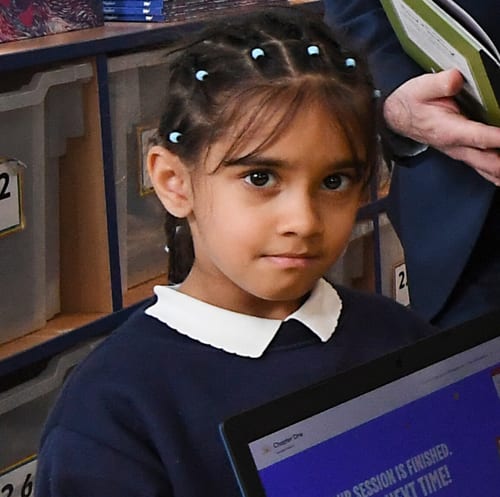
Asra's story: the power of persistence
With the persistent support of her volunteer, Asra is developing the confidence to engage with text, to make connections, and to find joy in storiesFind out more